The Block Buyer’s Handbook: Specs, Sizes, and Strengths Explained

The Block Buyer’s Handbook: Specs, Sizes, and Strengths Explained

Concrete Blocks Guides

Concrete blocks may look straightforward, but buying them isn’t. Behind every successful project is a series of correct decisions, not just about block type, but about dimensions, load performance, delivery format, and ordering efficiency.

This handbook breaks concrete block buying down the way experienced contractors actually think about it, from site requirements to truckload planning, with clarity on specs, sizes, and strengths that matter on real projects in the UAE.

Think Like a Block Buyer, Not Just a Builder

Most construction delays don’t happen because the wrong block exists, they happen because the wrong block was ordered, sized, or delivered too late.

Professional buyers focus on:

  • Structural performance
  • Site handling efficiency
  • Quantity per truck
  • Speed of replenishment

Understanding these factors upfront saves time, labour, and rework.

Block Types Explained Through Practical Use

Hollow Blocks: Efficiency at Scale

Hollow blocks are designed for projects where speed, weight reduction, and handling efficiency are critical.

Common applications:

  • Structural walls in residential and commercial buildings
  • Partition walls
  • Multi-floor construction

Why buyers choose them:

  • Lower dead load on the structure
  • Faster installation
  • More blocks per truck compared to solid blocks
  • Balanced strength-to-weight ratio

Hollow blocks are often selected when construction pace matters as much as strength.

Solid Blocks: When Load Comes First

Solid blocks are chosen when mass and compressive strength are non-negotiable.

Common applications:

  • Load-bearing walls
  • Foundations
  • Boundary walls
  • Industrial buildings

Why buyers choose them:

  • Higher density
  • Better resistance to impact
  • Consistent performance under heavy loads

Solid blocks are typically ordered for critical structural zones, not entire buildings.

Insulated Blocks: Built for UAE Conditions

Insulated blocks integrate a thermal layer into the block itself, reducing heat transfer.

Common applications:

  • Villas
  • Commercial buildings
  • Projects requiring energy compliance

Why buyers choose them:

  • Improved thermal performance
  • Reduced cooling load
  • Compliance with local authority requirements
  • Cleaner wall assembly without added insulation layers

These blocks are increasingly selected during design stage, not as an afterthought.

Block Sizes: Why Dimensions Affect More Than Walls

Block sizes and strength

Block size impacts more than thickness, it directly affects:

  • Structural capacity
  • Mortar usage
  • Handling time
  • Truck utilisation

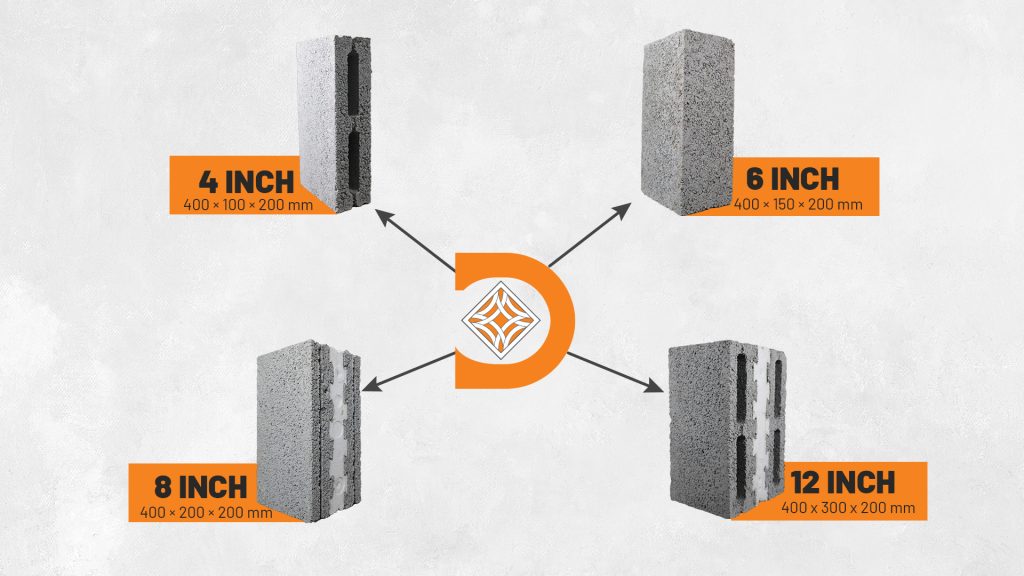
Common block sizes used in UAE projects

  • 400 × 100 × 200 mm (4-inch)
  • 400 × 150 × 200 mm (6-inch)
  • 400 × 200 × 200 mm (8-inch)
  • Larger insulated sizes for thermal applications

Larger blocks often mean:

  • Fewer joints
  • Faster wall completion
  • Fewer trips to site

Choosing size is not just structural; it’s logistical.

Understanding Strength Without Over-Specifying

Compressive strength defines how much load a block can handle, but over-specifying strength can inflate costs unnecessarily.

Smart buyers match:

  • Load requirements
  • Building height
  • Wall function

to the appropriate block strength, rather than defaulting to the highest option.

This approach keeps projects:

  • Cost-efficient
  • Structurally compliant
  • Easier to execute

The Hidden Factor: Buying by Truckload

On large projects, blocks aren’t bought by piece, they’re bought by truckload.

This matters because:

  • Different block sizes fit different quantities per truck
  • Truck-based ordering simplifies planning
  • It aligns better with site unloading and storage

Modern procurement focuses on how fast the next truck arrives, not just what’s inside it.

From Factory to Cart: How Online Ordering Changes Block Buying

Traditionally, ordering blocks meant phone calls, price confirmations, and manual follow-ups.

Today, professional buyers increasingly prefer:

  • Live pricing
  • Quantity control
  • Immediate order confirmation
  • Cart-based purchasing

With platforms like 800Blocks, buyers can:

  • Select block type and size
  • Adjust truck quantities instantly
  • View order totals in real time
  • Place orders without delays

This approach reduces procurement friction and keeps sites supplied without interruptions.

Choosing the Right Block Is About Control

The best block choice is the one that gives you:

  • Structural reliability
  • Predictable delivery
  • Accurate quantities
  • Minimal downtime

When specs, sizes, strength, and ordering methods align, projects move faster and margins stay intact.

Concrete blocks haven’t changed much in appearance, but the way smart teams buy them has.

Understanding block performance is important.
Understanding how to order them efficiently is what keeps projects on track.

Planning your next order?

Explore Ducon’s concrete blocks and place orders online through 800Blocks, built for speed, accuracy, and site-ready delivery.