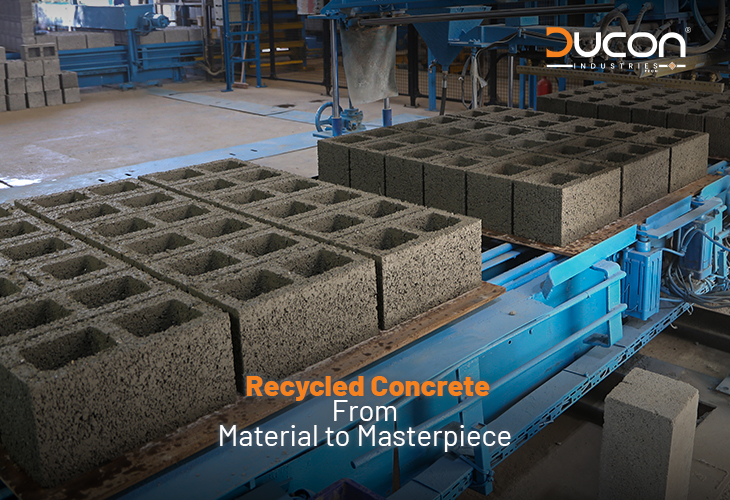
Recycled Concrete: How Ducon Is Turning Waste into Strength

Recycled Concrete: How Ducon Is Turning Waste into Strength

Sustainable Construction

Recycled concrete, made from CDEW (Construction, Demolition, Excavation Waste)  is a smart, sustainable material. 

In this blog, we explain in simple words what recycled concrete is, why it matters, how Ducon’s circular model works, and how Ducon’s different units play a role.

What Is Recycled Concrete?

Recycled concrete blocks

When buildings, roads, or structures are demolished or excavated, large volumes of concrete, masonry, soil, etc., are produced. This is called CDEW (Construction, Demolition, Excavation Waste).

  • Instead of dumping all that waste into landfills, we can crush, clean, sort, and reprocess the concrete pieces into new usable aggregates.
  • That processed material is called recycled concrete, or recycled concrete aggregate (RCA).

You can then use RCA in new concrete, in blocks, in pavements, in sub-bases, or as fill.

Benefits of Recycled Concrete

Using recycled concrete brings multiple advantages:

  • Less landfill & waste: Keeps demolition waste out of landfills.
  • Lower cost: You save on raw aggregate, transport, and disposal fees.
  • Environmental wins: Less quarrying, fewer emissions, less resource extraction.
  • Circular economy: Waste becomes resource again, closing the loop.
  • Local sourcing: Recycled materials come from your own site or nearby, reducing complications.
  • Sustainability credentials: Helps projects meet green building or sustainability standards.

However, quality control is key. The recycled material must be processed properly to ensure strength, durability, and safety.

Ducon’s Circular Economy: From Demolition to Product

Recycled concrete - Circular economy

Ducon has built an internal loop: Ducon Eco → Ducon Green → Ducon Ind → Ducon ODL → Ducon Force.

Here’s how the cycle works:

  1. Ducon Eco – Handles demolition, waste collection, and transport of CDEW.
  2. Ducon Green – Receives CDEW, processes it (crushing, cleaning, sorting) into recycled concrete aggregates (RCA) and “green concrete.”
  3. Ducon Ind – Uses recycled concrete and aggregates in manufacturing concrete blocks, pavers, interlocks, kerbstones, etc.
  4. For reference, Ducon has a C&D recycling facility visited by Dubai Municipality.

Ducon Outdoor Living – Showcase concrete products (blocks, pavers, landscape hardscapes) in outdoor, landscaping, patios, etc.

As sustainable design becomes a priority for landscaping companies in Abu Dhabi, Ducon ODL provides eco-friendly, durable products that align perfectly with their vision, longer-lasting outdoor projects.
ODL is about turning outdoor space into beautiful, functional environments using sustainable materials too. Duconodl

Ducon Force – Ducon force is handling delivery, installation and maintenance.

Hence, waste from demolition is converted into building blocks, pavers, landscaping materials, closing the loop.

How our divisions work together

  • Ducon Eco – Demolition, collection, transporattion of CDEW (Duconeco)
  • Ducon Green – Processing waste into recycled concrete, green concrete ( Ducon Green)
  • Ducon Ind – Manufacturing concrete blocks, pavers that may include recycled aggregate (Duconind)
  • Ducon ODL – Ducon ODL highlights the products that we finalize for outdoor landscaping and hardscape solutions (Duconodl)
  • Ducon Force – Delivery, installation and maintenance.

This structure helps Ducon control quality, reduce waste, and offer sustainable products in the UAE.

Why Recycled Concrete Makes Sense in UAE?

Limited land, costly waste.

  • Transport costs are high; using local waste reduces haul distance.
  • The UAE is pushing sustainability, green buildings, reduced carbon footprint.
  • Climate: Using durable materials is essential; properly processed recycled concrete can meet that.

As shown in the graph above, concrete accounts for the highest proportion of construction and demolition waste, almost 70–75% of total C&D debris.

This emphasizes the urgent need to recycle concrete instead of sending it to landfills.

Through Ducon’s circular model, this waste is transformed into recycled concrete aggregates and sustainable building materials, closing the loop in the construction cycle.

Why Builders Are Switching to Recycled Concrete

Why Builders Are Switching to Recycled Concrete
Recycling concrete isn’t just about reducing waste, it’s about reshaping how we build. Here are some of the biggest advantages:

  1. Less pressure on natural resources
    When you reuse old concrete, you reduce the need to dig up new sand, gravel, or stone. That means fewer quarry operations, less fuel burned for transport, and a smaller impact on the environment.
  2. Lower carbon footprint
    Producing concrete from recycled aggregates (RCA) releases fewer emissions than manufacturing concrete from virgin materials. Every ton of RCA used helps cut down CO₂ output and supports the UAE’s decarbonization goals.
  3. Smaller landfill footprint
    Construction and demolition waste makes up a huge portion of what ends up in landfills. Recycling concrete keeps this material in use and out of dumps, extending landfill life and reducing disposal costs.
  4. Lighter, smarter concrete
    Recycled concrete offers the same density as new concrete, providing the same strength and performance for construction and paving projects.
  5. Cost efficiency
    Because recycled concrete uses existing materials and requires less long-distance hauling, production costs are generally lower. The savings can be significant, especially for large-scale developments.
  6. A step toward a circular economy
    Instead of a “take–make–waste” model, recycled concrete creates a loop, demolished materials feed into new projects. It’s a win for business, the environment, and future generations.

Why Ducon

If you believe in building smarter, greener, and stronger  Ducon is already one step ahead.

Every Ducon division plays a role in turning construction waste into sustainable products that last.

Choosing Ducon means choosing a circular future and where what you build today becomes the foundation for tomorrow.