5 Common Mistakes When Ordering Concrete Blocks (And How to Avoid Them)
 admin
admin
Today you’ll discover the exact mistakes that cost construction teams thousands of dirhams when ordering concrete blocks.
And more importantly:
How to avoid them completely.
In fact, these five mistakes account for over 70% of material waste and project delays on UAE construction sites.
Let’s dive right in.
Quick Summary
If you only have 60 seconds, here’s what you need to know about ordering concrete blocks:
- Mistake #1: Ordering the wrong block type costs 15-25% more in material expenses
- Mistake #2: Incorrect quantity calculations lead to expensive rush orders or wasted materials
- Mistake #3: Ignoring delivery timing creates storage problems and damaged inventory
- Mistake #4: Skipping supplier verification results in substandard products and project failures
- Mistake #5: Overlooking specification details causes installation issues and structural risks
Strategic ordering saves money, prevents delays, and ensures project success.
Now let’s break down each mistake in detail.
Mistake 1: Ordering the Wrong Block Type (The 15-25% Cost Mistake)
This is the #1 most expensive mistake contractors make when ordering concrete blocks.
Here’s what happens:
You order standard hollow blocks for a load-bearing wall. The engineer rejects them. Now you’re stuck with unusable inventory and need rush delivery of solid blocks.
The real cost? Not just the wasted blocks. It’s the project delay, emergency delivery fees, and labor downtime.
Why This Mistake Happens
Most people think “concrete blocks are concrete blocks.”
Wrong.
According to our manufacturing data from over 50 years at Ducon Industries, there are three fundamentally different block types, each engineered for specific applications:
- Hollow Blocks – Lightweight, thermal-efficient, ideal for non-load-bearing walls
- Solid Blocks – Maximum compressive strength for load-bearing structures
- Insulated Blocks – Polystyrene core for energy efficiency in residential projects
The mistake comes from focusing on price instead of application.
The Selection Framework That Actually Works
Here’s the exact process project managers at Dubai’s top construction firms use when ordering concrete blocks:
Step 1: Identify Your Wall Function
Ask yourself:
- Is this a load-bearing wall? → Solid blocks
- Is this a partition or boundary wall? → Hollow blocks
- Do you need thermal performance for a villa? → Insulated blocks
Step 2: Check Your Structural Requirements
Review your approved drawings and specifications. Look for:
- Compressive strength requirements (measured in N/mm²)
- Load calculations from your structural engineer
- Building code compliance requirements
Step 3: Match Environmental Conditions
In the UAE climate, this matters more than most people realize.
For example:
- External walls exposed to heat → Hollow or insulated blocks for thermal protection
- Boundary walls → Standard hollow blocks work perfectly
- Basement or ground-floor load-bearing → Solid blocks with low chloride
The Quick Decision Tool
Use this simple chart before you place your next order:
Application | Recommended Block Type | Key Benefit |
Load-bearing walls, foundations | Solid Blocks | Maximum strength (12.5 N/mm²) |
Partition walls, interior divisions | Hollow Blocks | Cost-effective, faster installation |
Villa external walls, energy-conscious builds | Insulated Blocks | 30-40% better thermal performance |
Boundary walls, perimeter fencing | Hollow Blocks | Light, affordable, sufficient strength |
Pro tip from our technical team: When in doubt, consult your structural engineer before ordering concrete blocks. A 15-minute conversation can save you tens of thousands of dirhams.
How to Order the Right Block Type Every Time
Follow this exact process:
- Get your approved structural drawings – Never order without them
- Highlight wall specifications – Note load-bearing vs non-load-bearing
- Match block type to function – Use the decision table above
- Verify with your engineer – Get sign-off before placing the order
- Request specifications from your supplier – Ensure compliance with UAE standards
When you order the right block type from the start, you avoid the costly correction cycle entirely.
Next up: The quantity calculation mistake that leaves contractors scrambling for emergency deliveries.
Mistake 2: Getting Quantities Wrong (The Emergency Delivery Trap)
Here’s a scenario that plays out on UAE construction sites almost daily:
Week 3 of construction. Your crew runs out of blocks. The project stops. You call your supplier for an emergency delivery.
The result?
- Rush delivery
- Labor sitting idle at full pay
- Project timeline slipping
- Contractor confidence dropping
This happens because of one thing: poor quantity calculation when ordering concrete blocks.
Why Standard Calculations Fail in the Real World
Most quantity calculations look something like this:
Wall Area ÷ Block Size = Blocks Needed
Sounds logical, right?
The problem is, this formula ignores the realities of construction:
- Breakage during handling (typically 2-5%)
- Cutting waste around windows and doors (3-7%)
- Damaged units from storage or delivery (1-3%)
- Design changes mid-project (variable)
When you order exactly what the basic calculation suggests, you’re guaranteed to run short.
The Professional Quantity Formula
After managing block deliveries for over 50 years, here’s the formula that actually works:
Total Blocks = [(Wall Area ÷ Block Coverage) × (1 + Waste Factor)] + Design Buffer
Where:
- Wall Area = Total square meters to be built
- Block Coverage = Surface area of one block (typically 0.08 m² for standard 400×200mm blocks)
- Waste Factor = 8-12% for typical projects (0.08 to 0.12)
- Design Buffer = 3-5% additional for changes (0.03 to 0.05)
For example:
You’re building a boundary wall:
- Wall area: 500 m²
- Standard hollow block coverage: 0.08 m² per block
- Waste factor: 10% (0.10)
- Design buffer: 5% (0.05)
Calculation:
Total = [(500 ÷ 0.08) × (1 + 0.10)] + (500 ÷ 0.08 × 0.05)
Total = [6,250 × 1.10] + 312.5
Total = 6,875 + 313 = 7,188 blocks
Compare that to the basic calculation: 500 ÷ 0.08 = 6,250 blocks
You’d be short by 938 blocks – enough to stop work for 1-2 days while waiting for emergency delivery. (Dont worry, Not at Ducon; we have delivery available within 4 hours.)
The Breakage Factor No One Talks About
Through our delivery data across thousands of UAE construction sites, we’ve identified that breakage rates vary significantly based on three factors:
- Site Accessibility
- Easy access (paved roads, organized site): 2-3% breakage
- Moderate access (unpaved, some obstacles): 4-6% breakage
- Difficult access (tight spaces, manual handling): 7-10% breakage
- Storage Conditions
- Proper pallets, covered storage: 1-2% additional damage
- Ground storage, no cover: 4-6% additional damage
- Poor organization, high traffic area: 8-12% additional damage
- Timeline
- Short projects (under 2 months): Standard waste factor
- Long projects (3-6 months): Add 2-3% for extended storage
- Phased projects (6+ months): Add 4-5% for inventory turnover
The Over-Ordering Trap (And How to Avoid It)
Now here’s the flip side:
Ordering too many blocks creates different problems:
- Unnecessary capital tied up in materials
- Expensive storage space requirements
- Higher risk of weather damage over time
- Disposal costs for excess inventory
The solution? Use phased ordering when possible.
Strategic Phased Ordering
Instead of ordering all blocks upfront, structure your order in phases aligned with construction progress:
Phase 1: Foundation & Ground Floor (Week 1-3)
- Order 60% of total estimated blocks
- Ensures work starts immediately
- Limits storage requirements
Phase 2: Upper Floors (Week 4-6)
- Order 30% based on actual consumption from Phase 1
- Adjust quantities based on real breakage rates
Phase 3: Final & Contingency (Week 7+)
- Order remaining 10% plus small buffer
- Cover design changes and final requirements
The advantage? You’re ordering concrete blocks based on actual site data, not just theoretical calculations.
The Supplier Relationship That Saves Projects
Here’s something most contractors don’t leverage:
Supplier flexibility.
At Ducon Industries, we’ve built our operations around this reality: construction doesn’t follow perfect plans.
That’s why we offer:
- 4-hour delivery maximum across Dubai and Sharjah
- 24/7 operations so emergency orders don’t wait until tomorrow
- Order adjustments without penalties for active projects
- Just-in-time delivery for tight sites with limited storage
When you work with a responsive supplier, you can order more conservatively, knowing backup is always available.
Your Quantity Calculation Checklist
Before you order your next concrete block delivery, run through this:
- Calculate base quantity using wall area and block coverage
- Add waste factor (8-12% depending on site conditions)
- Include design buffer (3-5% for changes)
- Factor in site accessibility (adjust waste for difficult access)
- Consider project timeline (add more for longer storage periods)
- Verify supplier delivery capability (ensure fast turnaround for top-ups)
- Plan phased delivery if project spans multiple months
Pro tip: Keep detailed records of actual usage versus ordered quantities across projects. Your historical data becomes the most accurate predictor for future orders.
Next up: The delivery timing mistake that turns job sites into chaotic storage nightmares.
Mistake 3: Ignoring Delivery Timing (The Storage Disaster)
This mistake doesn’t show up in your initial budget.
It shows up when:
- Your site is cluttered with early deliveries blocking access
- Blocks sit on bare ground absorbing moisture for weeks
- Your next trade can’t access their work area because blocks are in the way
- Inspection reveals efflorescence and staining from improper storage
The cost? Damaged materials, site inefficiency, and potential structural quality issues.
Why Delivery Timing Matters More Than You Think
Most contractors order concrete blocks like they’re ordering office supplies:
“We need them for the project. Order them all now.”
But concrete blocks aren’t paper clips. They’re:
- Heavy (12-18 kg per block for standard sizes)
- Space-intensive (1,000 blocks = roughly 15 cubic meters)
- Moisture-sensitive (absorb water from ground contact)
- Fragile under poor conditions (edges chip, surfaces stain)
When blocks arrive too early, they become a liability instead of an asset.
The Hidden Cost of “Too Early” Deliveries
Let’s break down what actually happens when you order too far in advance:
Week 1-2 After Early Delivery:
- Blocks occupy prime site space
- Other materials and equipment can’t access optimal locations
- Site flow becomes inefficient
Week 3-4:
- Ground moisture starts affecting blocks in contact with soil
- Surface staining begins, especially during UAE’s humid months
- Some edge chipping from repeated handling and repositioning
Week 5-6:
- Visible efflorescence appears on blocks
- Some units now require rejection or demotion to non-visible applications
- Storage costs (if off-site) or opportunity costs (if on-site) accumulate
The “Just Too Late” Problem
The opposite mistake is just as painful:
Ordering blocks right when you need them sounds smart. But:
- Supplier stock may be low during peak construction season
- Delivery schedules might be fully booked 2-3 days out
- Quality checking requires time before installation begins
- Site prep for receiving large deliveries takes coordination
When blocks arrive late:
- Crew stands idle
- Project timeline slips
- Subsequent trades get delayed
- Client confidence erodes
The Staggered Delivery Strategy
Here’s an advanced approach used by Dubai’s most efficient contractors:
Instead of one massive delivery, break it into synchronized deliveries matching construction pace:
Example: 10,000-block project
Traditional Approach:
- One delivery of 10,000 blocks
- Requires 20+ sqm of storage space
- Blocks sit 4-8 weeks on average
- High damage and handling costs
Staggered Approach:
- Delivery 1: 3,500 blocks (Week 1) – Foundation and ground floor
- Delivery 2: 3,500 blocks (Week 3) – Upper floor starts
- Delivery 3: 2,500 blocks (Week 5) – Final walls
- Delivery 4: 500 blocks (Week 6) – Contingency and minor work
Benefits:
- Only 5-7 sqm storage needed at any time
- Maximum 2-week storage duration per batch
- Minimal damage and handling
- Site stays organized and accessible
The catch? This only works with suppliers who offer reliable, fast delivery.
That’s why Ducon’s 4-hour delivery guarantee and 24/7 operations enable this efficient approach.
Site-Specific Timing Considerations
Your delivery timing should also account for:
- Site Size and Access
- Large open sites: Can handle bigger deliveries, but weather exposure is higher
- Tight urban sites: Require smaller, more frequent deliveries to avoid congestion
- Multi-story buildings: Coordinate deliveries with crane/hoist availability
- Weather Conditions
- Summer months (June-September): Minimize storage time due to extreme heat
- Winter months (December-February): Slightly more flexibility, but watch for rare rain
- Humid periods: Avoid ground storage entirely; use pallets always
- Project Phase
- Starting phase: Small initial delivery to confirm quality and site readiness
- Main phase: Regular rhythm matching crew productivity
- Finishing phase: Conservative orders to avoid excess inventory
The Storage Protocol That Protects Your Investment
When blocks do arrive on-site, follow this protocol based on our complete storage guide:
Immediate Actions (Within 1 Hour of Delivery):
- Off-ground placement – Use pallets or timber dunnage (min. 75mm clearance)
- Level base – Ensure surface is compacted and stable
- Running bond stacking – Stagger blocks for stability
- Height limits – Follow supplier recommendations (typically max 1.5-2.0m)
- Weather protection – Cover with breathable tarps if staying >48 hours
Ongoing Storage (If Required):
- Weekly inspection – Check for moisture, damage, settling
- Cover maintenance – Ensure tarps haven’t trapped moisture
- Access management – Keep high-traffic areas clear of stored blocks
Working With Your Supplier on Timing
Here’s what to discuss with your supplier when ordering concrete blocks:
Questions to ask:
- “What’s your standard delivery timeframe?”
At Ducon: Maximum 4 hours for Dubai/Sharjah orders - “Can you handle split deliveries aligned with our construction schedule?”
At Ducon: Yes, we coordinate multiple deliveries for phased projects - “What’s your delivery window during peak season?”
Important for planning during Oct-April construction boom - “Do you offer schedule flexibility if our timeline shifts?”
At Ducon: 24/7 operations provide maximum flexibility - “What notice do you need for delivery changes?”
Understand minimum lead time for adjustments
Suppliers with their own fleet (like Ducon’s fully-owned delivery trucks) offer better control and flexibility than those relying on third-party logistics.
Your Delivery Timing Checklist
Before you finalize your order, confirm:
Installation start date is confirmed and realistic
Storage space is prepared and adequate
Site access will be clear on delivery day
Handling equipment (if needed) will be available
Storage materials (pallets, covers) are ready
Weather forecast checked for delivery day
Delivery schedule aligns with other site activities
Backup storage plan exists if delays occur
Smart timing when ordering concrete blocks saves money, protects quality, and keeps projects moving smoothly.
Next up: The supplier verification mistake that can compromise your entire project.
Mistake 4: Skipping Supplier Verification
This is the mistake that feels safe at the time.
You find a supplier offering blocks at 15% below market rate. The quote looks professional. They promise fast delivery.
You place the order.
Then the blocks arrive and:
- Dimensions are inconsistent (creates alignment issues)
- Strength ratings don’t match specifications (fails inspection)
- Chloride content is high (corrosion risk in reinforced walls)
- Surface quality is poor (visible in finished work)
Now you’re facing:
- Rejection by consultants or inspectors
- Project delays while sourcing compliant materials
- Potential structural risks
- Relationship damage with your client
All because you didn’t verify your supplier before ordering concrete blocks.
Why Supplier Verification Gets Skipped
It comes down to three assumptions:
Assumption #1: “They’re a registered business, so they must be legitimate”
Registration means they filed paperwork. It doesn’t mean they:
- Manufacture to UAE standards
- Maintain consistent quality
- Test batches regularly
- Use proper raw materials
Assumption #2: “Their price is competitive, so they must be efficient”
Low prices often mean:
- Substandard raw materials
- Skipped quality testing
- Inconsistent manufacturing processes
- Lack of proper certifications
Assumption #3: “I don’t have time to vet suppliers mid-project”
True. But you’ll spend 10x more time fixing problems from an unverified supplier.
One hour of verification saves weeks of headaches.
The Real Cost of Bad Suppliers
Let’s look at actual numbers from a commercial project in Business Bay:
The Scenario:
- Contractor selected supplier based solely on price
- Ordered 12,000 blocks for structural work
- Saved AED 9,000 versus established suppliers (15% discount)
The Outcome:
- Blocks failed compressive strength testing
- Engineer rejected entire delivery
- Project delayed 18 days while sourcing replacements
- Client penalty: AED 54,000
- Replacement blocks at rush rates: AED 72,000 (premium pricing)
- Disposal of rejected blocks: AED 6,000
Total impact: AED 132,000 loss to save AED 9,000
That’s a 1,367% negative return on the “savings.”
The 7-Point Supplier Verification System
Based on 50+ years of manufacturing experience, here’s exactly what to verify before ordering concrete blocks:
Verification Point #1: Manufacturing Certifications
What to check:
- ISO 9001:2015 (Quality Management)
- ISO 14001:2015 (Environmental Management)
- ISO 45001:2018 (Health & Safety)
Why it matters:
These certifications confirm systematic quality control, not just one-time compliance.
Red flag: Supplier can’t produce current certification documents when asked.
Ducon example: We maintain all three ISO certifications, updated annually, available for client verification.
Verification Point #2: Product Testing & Compliance
What to check:
- Dubai Central Laboratory (DCL) certification
- Regular batch testing reports
- Compliance with UAE building codes
- Test frequency (should be per batch, not annual)
Why it matters:
Concrete blocks must meet specific compressive strength, chloride content, and sulphate content standards. Without regular testing, you’re gambling on structural safety.
What to ask for:
- Recent test reports (within last 30 days)
- Batch traceability system
- Certification from recognized testing facility
Red flag: “We test regularly but reports aren’t available” = they probably don’t test regularly.
Verification Point #3: Manufacturing Process Transparency
What to check:
- Factory location and tour availability
- Production capacity (ensures they can meet your timeline)
- Raw material sources (affects quality consistency)
- Quality control procedures at each stage
Why it matters:
Suppliers confident in their process welcome scrutiny. Those hiding something will be evasive.
Smart question to ask:
“Can I visit your manufacturing facility to see the process?”
Legitimate manufacturers say yes.
Questionable suppliers make excuses.
Verification Point #4: Industry Recognition & Memberships
What to check:
- CMHA (Concrete Masonry & Hardscape Association) membership
- ICPI (Interlocking Concrete Pavement Institute) certification
- Industry awards or recognition
- Years in business (track record matters)
Why it matters:
Industry associations require standards compliance for membership. Recognition from peers signals reliability.
Ducon example: We’re proud members of CMHA and ICPI-certified installers, with design awards dating back to 2013.
Verification Point #5: Supply Chain & Delivery Capability
What to check:
- Own fleet vs. third-party logistics
- Delivery coverage area
- Average delivery timeframes
- Emergency/rush delivery options
- Delivery tracking systems
Why it matters:
Supply chain reliability prevents project delays. Suppliers with owned fleets offer better control and flexibility.
Questions to ask:
- “Do you own your delivery vehicles or use third-party?”
- “What’s your standard delivery window?”
- “Can you handle same-day or emergency deliveries?”
Red flag: Vague answers about delivery timing or no specific SLA (Service Level Agreement).
Ducon advantage: Fully-owned fleet, 4-hour maximum delivery, 24/7 operations.
Verification Point #6: Track Record & References
What to check:
- Client references (contactable project managers)
- Portfolio of completed projects
- Online reviews and reputation
- Complaint resolution process
Why it matters:
Past performance predicts future reliability.
What to do:
- Ask for 3-5 recent client contacts
- Actually call them (don’t skip this)
- Ask specific questions:
- “Did materials meet specifications?”
- “Were deliveries on time?”
- “How was communication?”
- “Would you use them again?”
Red flag: Supplier hesitates to provide recent references or only offers very old projects.
Verification Point #7: Technical Support & Expertise
What to check:
- Access to technical specialists
- Specification guidance capability
- Problem-solving support during projects
- Educational resources (guides, documentation)
Why it matters:
Ordering concrete blocks isn’t just about getting boxes delivered. Technical questions arise. Good suppliers become partners, not just vendors.
Questions to ask:
- “Who can I contact for technical questions?”
- “Do you provide specification support?”
- “What happens if there’s an issue with the blocks?”
Ducon example: Our team has decades of combined experience, and we publish detailed guides on topics like storage best practices, block type selection, and avoiding construction mistakes.
The Fast Verification Process for Busy Contractors
“This sounds thorough, but I don’t have days to spend on verification.”
Fair point. Here’s the 15-minute verification process:
Step 1 (5 minutes): Document Check
- Request and review: Current ISO certificates, DCL certification, recent test reports
- Legitimate suppliers email these within hours
Step 2 (5 minutes): Online Research
- Google: “[Supplier name] reviews”
- Check: Company website, LinkedIn presence, years in operation
- Look for: Red flags (complaints, quality issues) or green flags (awards, certifications)
Step 3 (5 minutes): Reference Call
- Call ONE recent client reference
- Ask the four key questions above
- Listen for enthusiasm vs. hesitation in their responses
Total time: 15 minutes
Potential savings: Tens of thousands of dirhams + project delays
If a supplier passes this quick check, proceed with confidence.
If they fail any point, dig deeper or move on.
Why Ducon Industries Passes Every Verification Point
We’re not just saying we’re qualified. We can prove it:
ISO 9001, 14001, 45001 certified (updated annually)
DCL certified for construction materials
CMHA member & ICPI certified installer
50+ years serving UAE construction industry
Award-winning designs (2013-2015 hardscape projects)
Owned fleet = reliable 4-hour delivery
24/7 operations for maximum flexibility
Published expertise through comprehensive educational blog
Verified client testimonials from projects across Dubai and UAE
Most importantly: We welcome verification.
Ask us for certifications. Request test reports. Want to visit our facility? Contact us.
Suppliers confident in their quality don’t hide behind excuses.
Your Supplier Verification Checklist
Before ordering concrete blocks, confirm your supplier has:
Current ISO certifications (9001, 14001, 45001)
DCL or equivalent testing certification
Recent batch test reports (within 30 days)
Industry association membership (CMHA, ICPI, etc.)
Owned delivery fleet or proven logistics partner
Clear delivery timeframes and SLAs
Contactable client references (and you actually called them)
Technical support availability
Transparent manufacturing process (factory tour offered)
Documented quality control procedures
Keep a pre-qualified supplier list. Do the verification once, then use them repeatedly. This saves time across multiple projects.
Next up: The specification detail mistake that causes expensive installation problems and structural risks.
Mistake 5: Overlooking Specification Details (The Installation Nightmare)
This is the mistake that seems minor until installation starts.
Your blocks arrive. Crew starts building. Then:
“These blocks don’t fit the opening properly.”
“The mortar isn’t bonding right.”
“Why are the dimensions inconsistent?”
“The engineer says the chloride content is too high for reinforced walls.”
The problem?
You ordered “8-inch concrete blocks” without specifying the details that actually matter.
Now you’re dealing with:
- Installation delays while resolving issues
- Additional cutting and adjustment labor
- Potential structural concerns
- Quality problems in the finished work
Why Specifications Get Overlooked
Most contractors think ordering concrete blocks is simple:
“I need 6-inch hollow blocks for this wall. How many and when?”
But that leaves out critical details that determine whether those blocks actually work for your specific application:
- Compressive strength rating
- Chloride and sulphate content
- Dimensional tolerances
- Surface finish requirements
- Special performance characteristics
The assumption: “All 6-inch blocks from certified suppliers are basically the same.”
The reality: Significant variations exist even among compliant products.
The 5 Specification Details That Matter Most
Detail #1: Compressive Strength Classification
Why it matters:
Not all blocks are engineered for the same loads.
Standard hollow blocks typically offer 7.5 N/mm² compressive strength.
Load-bearing variants provide 12.5 N/mm² or higher.
The mistake:
Ordering standard blocks for load-bearing applications, or over-specifying (and overpaying) for non-structural work.
What to specify:
- Non-load-bearing walls: 7.5 N/mm² is sufficient
- Load-bearing walls: 12.5 N/mm² minimum
- Heavy loads or special cases: Consult structural engineer for specific requirements
Red flag in your order: You didn’t mention compressive strength at all.
Smart order statement: “6-inch hollow blocks, 7.5 N/mm² compressive strength, for non-load-bearing partition walls.”
Detail #2: Chloride & Sulphate Content Limits
Why it matters:
High chloride content causes corrosion in reinforced concrete walls.
High sulphate content can cause concrete deterioration over time.
UAE standards:
- Chloride content: ≤0.05% recommended
- Sulphate content: ≤0.5% maximum
The mistake:
Never asking about chemical composition, especially for walls containing rebar.
When it’s critical:
- Any reinforced masonry
- Basement or ground-floor construction
- Walls exposed to moisture or coastal environments
- Structural elements with embedded steel
What to specify:
“Blocks must meet maximum 0.05% chloride content and 0.5% sulphate content per UAE standards.”
Ducon standard: All our blocks comply with these stringent requirements, documented in every batch test report.
Detail #3: Dimensional Accuracy & Tolerances
Why it matters:
Inconsistent dimensions create:
- Alignment problems during installation
- Excessive mortar use trying to compensate
- Visible quality issues in finished walls
- Increased labor time and cost
Standard block dimensions in UAE:
- 4-inch: 400mm × 100mm × 200mm
- 6-inch: 400mm × 150mm × 200mm
- 8-inch: 400mm × 200mm × 200mm
The mistake:
Assuming all blocks match these dimensions precisely.
Reality:
Manufacturing tolerances vary by supplier quality. Poor quality control = inconsistent sizing.
What to specify:
“Dimensional tolerance within ±3mm per UAE standards” (or whatever tolerance your engineer requires).
Smart tip: Order a sample batch first for critical projects. Measure 10 random blocks. If dimensions vary more than specified, reject that supplier.
Detail #4: Surface Finish & Appearance
Why it matters:
For walls that remain exposed or receive direct finishes (without plaster), surface quality affects final appearance.
Specification factors:
- Surface texture (smooth vs. textured)
- Color consistency (especially for exposed blockwork)
- Absence of cracks, chips, or manufacturing defects
- Clean faces without excess material
The mistake:
Not specifying surface requirements when it matters aesthetically.
When to specify carefully:
- Boundary walls that won’t be plastered
- Interior feature walls with exposed block
- Commercial projects with architectural block elements
- Any project where blocks remain visible
What to specify:
“Smooth surface finish, uniform color, free from chips or cracks, suitable for direct painting” (if applicable).
Detail #5: Special Performance Requirements
Why it matters:
Some applications need blocks with specific performance characteristics beyond basic structural requirements.
Common special requirements:
Thermal Performance:
- For energy-efficient buildings (villas, commercial spaces with climate control)
- Specify insulated blocks with documented thermal resistance values
- Important for LEED or Estidama sustainability ratings
Fire Resistance:
- For specific fire-rated wall assemblies
- May require blocks manufactured with certain aggregates
- Verify compliance with UAE Civil Defense requirements
Moisture Resistance:
- For below-grade or high-humidity applications
- May require special additives or manufacturing processes
- Critical in basements, ground-floor construction, coastal projects
What to specify:
State your performance requirement clearly: “Blocks for villa external walls requiring thermal performance better than standard hollow blocks” → Points to insulated blocks.
The Specification Communication Framework
When ordering concrete blocks, communicate specifications in this structured way:
Order Template:
PROJECT: [Project name and location]
APPLICATION: [Specific use – e.g., “Ground floor load-bearing walls”]
BLOCK TYPE: [Hollow / Solid / Insulated]
SIZE: [4-inch / 6-inch / 8-inch]
QUANTITY: [Number of blocks + waste factor]
STRENGTH: [Compressive strength in N/mm²]
DIMENSIONAL TOLERANCE: [±3mm or per engineer spec]
SPECIAL REQUIREMENTS: [Any thermal, fire, moisture, or surface specifications]
DELIVERY: [Required date and location]
COMPLIANCE: [Reference to UAE standards or project specs]
Example filled out:
PROJECT: Villa Construction, Emirates Hills, Dubai
APPLICATION: External walls, non-load-bearing
BLOCK TYPE: Insulated blocks
SIZE: 6-inch (150mm)
QUANTITY: 4,500 blocks (includes 10% waste factor)
STRENGTH: Minimum 7.5 N/mm²
DIMENSIONAL TOLERANCE: ±3mm
SPECIAL REQUIREMENTS: Thermal insulation for energy efficiency
DELIVERY: Thursday AM, site access via Gate B
COMPLIANCE: UAE building code + DCL standards
This level of detail ensures you get exactly what your project needs.
The Pre-Order Specification Meeting
Here’s a pro move: Before finalizing large orders, have a 15-minute specification review with your supplier’s technical team.
Cover these questions:
- “Do these specifications match the blocks you manufacture?”
- “Are there any specification conflicts or issues you see?”
- “What documentation can you provide proving compliance?”
- “Have you supplied similar specifications for comparable projects?”
- “What’s the lead time for this exact specification?”
Red flags:
- Vague answers or reluctance to discuss technical details
- “We can provide that but it’ll cost more” (for standard specs)
- Can’t produce compliance documentation
- Never dealt with these specifications before
Green flags:
- Clear, confident technical responses
- Offers to provide test reports and certifications
- References similar projects they’ve supplied
- Suggests improvements based on their experience
At Ducon: Our technical team has decades of combined experience. We welcome detailed specification discussions and can provide guidance when you’re unsure.
The Specification Verification Process
Don’t just trust what’s promised. Verify what’s delivered:
Upon Delivery:
Visual inspection – Check for obvious defects, damage, consistency
Dimension spot-check – Measure 5-10 random blocks
Documentation review – Verify batch numbers match test reports
Sample testing – For critical projects, send samples to independent lab
Before Installation:
Engineer sign-off – Have your consultant verify compliance
Test report submission – Provide supplier’s documentation for record
Storage condition check – Ensure blocks haven’t been compromised in storage
Don’t start installation until specifications are verified.
Fixing problems after walls are built is exponentially more expensive than catching issues before construction starts.
Working With Suppliers Who Understand Specifications
The difference between good and great suppliers:
Good suppliers provide blocks that meet basic standards.
Great suppliers:
- Help you understand which specifications matter for your application
- Proactively flag potential issues with your requirements
- Offer alternatives if better options exist
- Provide complete documentation without being asked
- Stand behind their specifications with verifiable testing
When you work with experienced manufacturers, you’re not just buying products—you’re accessing expertise that prevents costly mistakes.
Your Specification Checklist
Before placing your next concrete block order, confirm:
Compressive strength specified and appropriate for application
Chloride content ≤0.05% confirmed (especially for reinforced walls)
Sulphate content ≤0.5% confirmed
Dimensional tolerances specified (typically ±3mm)
Surface finish requirements stated if applicable
Special performance needs identified (thermal, fire, moisture)
Reference to standards included (UAE building code, DCL, etc.)
Compliance documentation requested from supplier
Engineer review of specifications completed
Verification process planned for delivery
The bottom line: Detailed specifications when ordering concrete blocks prevent installation problems, ensure structural compliance, and protect project quality.
Bonus Chapter: The Order Process That Prevents All Five Mistakes
Now you know the five costly mistakes.
But here’s the challenge:
“How do I remember all this when I’m managing three projects simultaneously?”
The answer: Use a systematic ordering process that builds in prevention.
The Digital Ordering Advantage
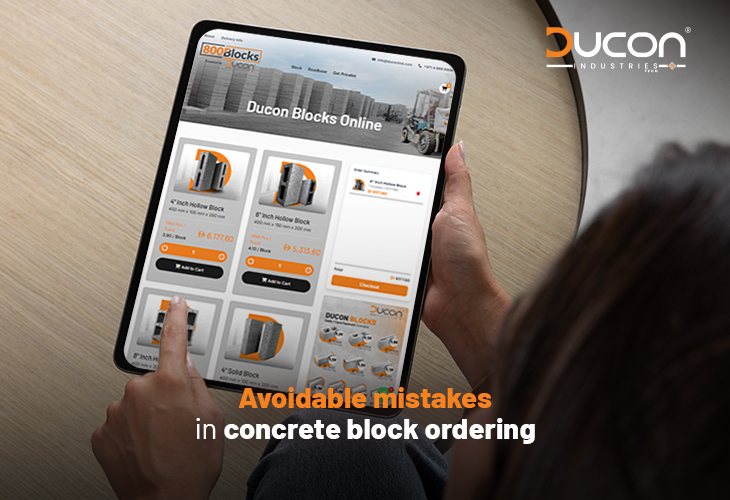
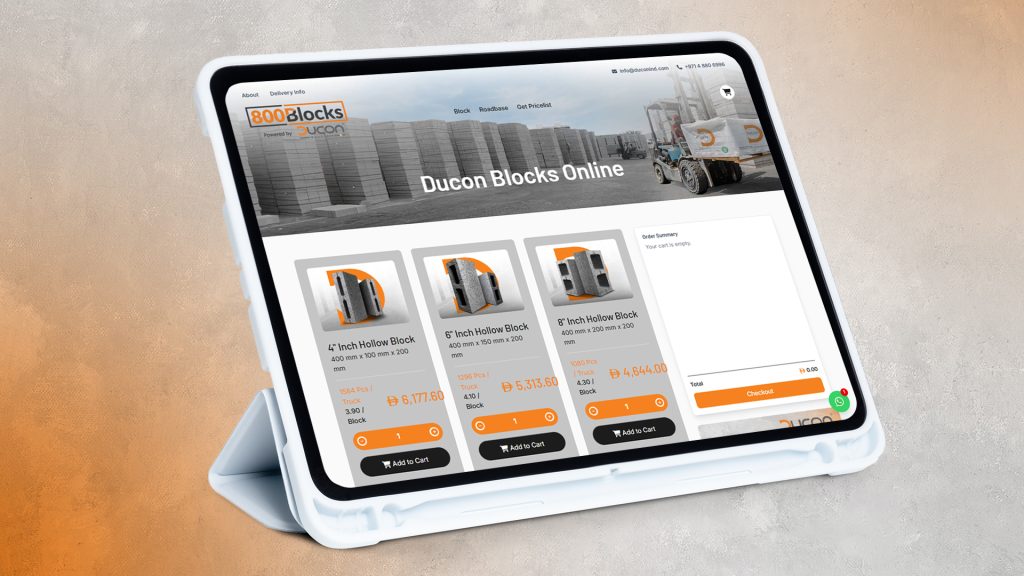
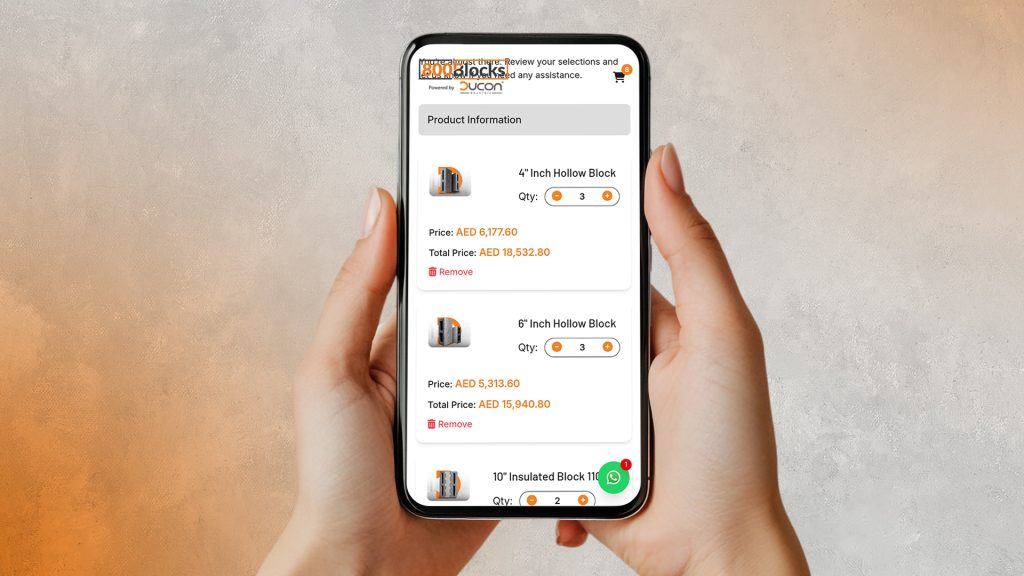
This is where online ordering platforms like 800Blocks transform the process.
Traditional ordering:
- Multiple phone calls
- Back-and-forth on specifications
- Manual quote comparisons
- Unclear delivery status
Digital ordering (800Blocks):
- Specifications built into product selection
- Instant availability confirmation
- Transparent pricing
- Order tracking in real-time
- Historical records for repeat orders
Result: Ordering concrete blocks becomes faster, more accurate, and fully documented.
The Supplier Partnership Approach
Beyond just using a good process, choose suppliers who become partners, not just vendors.
What that looks like in practice:
Transactional Supplier:
- Fulfills orders as specified
- Minimal communication
- No proactive support
- Relationship ends at delivery
Partner Supplier:
- Reviews specifications and suggests improvements
- Flags potential issues before they become problems
- Provides flexible delivery to match your schedule
- Offers technical support when needed
- Maintains consistent quality you can rely on
At Ducon Industries, we aim for the partnership model:
- Technical consultation before you order
- Flexible delivery (4-hour max, 24/7 availability)
- Quality documentation provided automatically
- Problem resolution if anything goes wrong
- Long-term reliability backed by 50+ years of experience
The value? You spend less time managing suppliers and more time managing projects.
Your Action Plan: Next Steps
Here’s exactly what to do after reading this guide:
If You’re Planning a Project:
Today (15 minutes):
- Bookmark this guide for reference
- Download or create your ordering checklist
- Start your supplier verification research
This Week (1 hour):
- Review your project specifications in detail
- Calculate quantities using the proper formula
- Contact 2-3 suppliers for verification (or choose a pre-verified supplier like Ducon)
Before Ordering (30 minutes):
- Complete all 10 steps of the error-proof ordering system
- Get specifications reviewed by your engineer
- Prepare site for receiving delivery
If You’re Ordering Right Now:
Immediate Checklist:
✅ Correct block type selected for each application
✅ Quantities calculated with proper waste factors
✅ Delivery timing aligned with installation schedule
✅ Supplier verification completed
✅ Complete specifications documented in order
✅ Storage area prepared
✅ Verification process ready for delivery
Then: Place your order with confidence.
If You’re Experiencing Problems:
If blocks are already ordered but not delivered:
- Review specifications with supplier immediately
- Verify delivery timing matches your updated schedule
- Confirm documentation will be provided
If blocks are delivered but problematic:
- Document issues immediately (photos, measurements)
- Contact supplier before starting installation
- Get engineer involved if structural concerns exist
If installation has started with wrong blocks:
- Stop work immediately
- Assess: Is this a safety issue or quality issue?
- Engage structural consultant for load-bearing concerns
- Document for supplier liability discussion
Frequently Asked Questions
Q: How far in advance should I order concrete blocks?
A: Depends on your supplier’s delivery capability.
With Ducon’s 4-hour delivery maximum and 24/7 operations: Order 2-3 days before installation for optimal freshness and storage minimization.
With suppliers having longer lead times: Order 1-2 weeks ahead, but be prepared for extended storage requirements.
For large projects (50,000+ blocks): Discuss phased delivery schedule with supplier at project start.
Q: Can I return unused concrete blocks?
A: Policies vary by supplier.
At Ducon: Returns of unused, undamaged blocks may be accepted with prior written authorization. Contact us before attempting returns.
Industry standard: Most suppliers don’t accept returns once delivered due to quality control concerns (they can’t verify storage conditions).
Smart approach: Order conservatively with a reliable supplier offering fast top-up delivery rather than over-ordering.
Q: How do I know if blocks meet UAE standards?
A: Request documentation:
✅ Dubai Central Laboratory (DCL) certification
✅ Batch test reports showing compressive strength, chloride, and sulphate content
✅ ISO 9001 certification confirming quality management systems
✅ Manufacturer compliance statement
Verify: Batch numbers on delivered blocks match test report documentation.
Red flag: Supplier can’t or won’t provide this documentation.
Q: What’s the difference between online ordering (800Blocks) and traditional phone orders?
Traditional phone ordering:
- Requires availability during business hours
- Verbal specifications (risk of miscommunication)
- Manual quote generation
- Limited order tracking
Online ordering (800Blocks):
- 24/7 ordering availability
- Specifications built into product selection (reduces errors)
- Instant pricing transparency
- Digital order tracking and history
- Faster processing
Best for: Online for routine orders; phone/email for complex custom specifications.
Q: Should I buy blocks directly from manufacturers or through distributors?
Direct from manufacturer (like Ducon) advantages:
- Better pricing (no middleman markup)
- Access to technical expertise
- Quality assurance (direct control)
- More flexible delivery options
Through distributor advantages:
- Sometimes stock diverse brands
- May have closer physical location
Our recommendation: For quality, support, and value, buy direct from established manufacturers.
Q: How do I handle specification changes mid-project?
Step 1: Document the change formally (email or change order)
Step 2: Contact your supplier immediately to discuss new specifications
Step 3: Get engineer sign-off on revised specs
Step 4: Verify lead time for new specification
Step 5: Determine what to do with original order (cancel, adjust, use elsewhere)
With responsive suppliers (like Ducon), specification changes can often be accommodated with minimal disruption if caught early.
Q: What should I do if delivered blocks don’t match specifications?
Immediate actions:
- Don’t start installation with questionable blocks
- Document the discrepancy (photos, measurements, batch numbers)
- Contact supplier immediately with documentation
- Get engineer opinion if structural implications exist
- Request replacement or credit
Legitimate suppliers will work quickly to resolve specification mismatches.
If supplier is uncooperative, this confirms you chose the wrong supplier (expensive lesson learned).
The Real Cost of Mistakes (And the Value of Getting It Right)
At the end of the day, ordering concrete blocks is about more than just buying materials.
It’s about:
- Protecting your project timeline (delays cascade expensively)
- Ensuring structural safety (you can’t compromise on load-bearing walls)
- Managing your budget (waste and rework destroy profitability)
- Maintaining your reputation (clients remember smooth projects)
The five mistakes we’ve covered—wrong block types, incorrect quantities, poor delivery timing, unverified suppliers, and overlooked specifications—account for the vast majority of material-related project problems.
But here’s the good news:
Every single one is 100% preventable.
It doesn’t require special expertise. It doesn’t take excessive time.
It requires:
- Understanding what actually matters (this guide gives you that)
- Process that builds in prevention (the checklists provided)
- Partners who support your success (reliable suppliers like Ducon)
When you get these three elements right, ordering concrete blocks becomes:
- Faster (systematic process is actually more efficient)
- Cheaper (avoiding waste and delays)
- Stress-free (confidence that materials will perform)
And your projects:
- Stay on schedule
- Meet specifications
- Stay within budget
- Build your reputation
That’s the compound value of getting it right.
Ready to Order Concrete Blocks the Right Way?
Whether you’re starting a villa project in Dubai, managing a commercial development, or handling residential construction, Ducon Industries has been the trusted choice for over 50 years.
What sets us apart:
Verified Quality – ISO certified, DCL approved, CMHA member
Technical Expertise – Over 50 years of manufacturing experience
Fast Delivery – Maximum 4 hours across Dubai and Sharjah
24/7 Operations – We work when construction doesn’t stop
Complete Product Range – Hollow, solid, and insulated blocks
Specification Support – Technical team helps you order exactly what you need
Sustainable Options – Recycled aggregate blocks for eco-conscious projects
Order online at 800Blocks.ae for the fastest, most convenient experience.
Or contact us:
- Phone: +971 4 880 6996
- Email: info@duconind.com
- Location: National Industries Park, Dubai, UAE
Explore our resources:
- Complete Storage Guide
- Hollow vs. Solid Blocks Comparison
- Construction Mistakes to Avoid
- Sustainable Recycled Blocks
Let’s build your next project right, starting with the right concrete blocks ordered the right way.
About the Author
This guide was developed by the technical team at Ducon Industries, drawing on over 50 years of manufacturing experience, thousands of successful projects across the UAE, and direct insights from contractors, engineers, and project managers who have navigated every challenge discussed in this article. Our commitment to the construction industry extends beyond supplying materials. We aim to empower builders with the knowledge to execute projects efficiently, safely, and successfully.